

Revisiting Les Miserables
Broward Center in Ft. Lauderdale
By: Aaron Krause - Dec 18, 2025
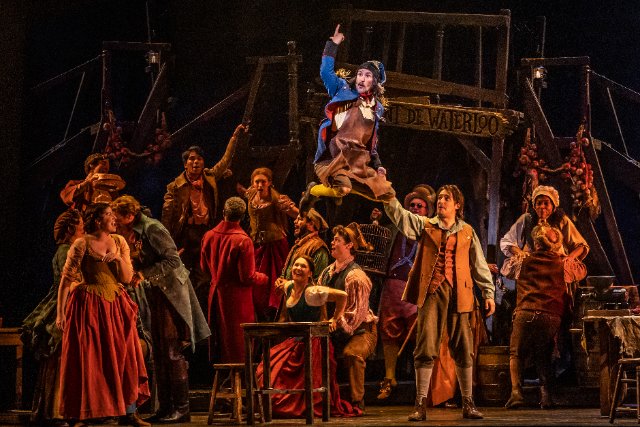


There’s a moment in the much-loved musical Les Misérables during which the theater feels more like a hushed house of worship than a conventional performance space. It comes when the protagonist, Jean Valjean, prayerfully asks God to keep student revolutionary Marius Pontmercy safe from the battle at the barricade.
These days, as Valjean’s soulful supplication rises during the equity national touring production, we want to pray with him — and quietly add an “Amen” at the end. That’s partly because the number “Bring Him Home” carries added resonance at the end of 2025. It has been a little more than two years since the Oct. 7, 2023 attacks and the taking of hostages in the Middle East, and in the time since, many have hoped and prayed for loved ones to return home alive and unharmed. In that context, it feels natural to follow performer Nick Cartell’s lead as he brings his hands together in prayer at the song’s conclusion.
The strong-voiced, expressive Cartell has embodied Valjean for more than 1,500 performances, and he continues to lend the character a quiet gravitas. Audiences can witness his nuanced portrayal yet again in Fort Lauderdale, where the touring production of Les Misérables remains at the Broward Center for the Performing Arts through Dec. 28 before heading to Hayes Hall in Naples. The running time is just under three hours, including an intermission.
A Musical That Endures
Classics endure because they remain relevant across multiple generations and stand the “test of time.” That’s what the stage musical version of Les Misérables has done since the release of a French concept album in 1980, based on Victor Hugo’s sprawling 1862 novel of the same name. That French title, in English, means The Miserable Ones, The Wretched, The Poor Ones, or The Victims. It refers to the downtrodden people of 19th-century France, focusing on the struggles of the poor, outcast, and oppressed — figures such as Valjean.
Even after multiple viewings, this beloved British 1980s megamusical reassures us anew that in a world full of pain and evil, goodness exists. We exit the theater reinvigorated, with renewed hope that a Jean Valjean exists within our own midst. In addition, the show reminds us that human beings possess a tremendous capacity to change for the better.
A Reimagined Spectacle
The production currently at the Broward Center isn’t the Les Misérables that previous generations experienced, complete with its famed turntable stage. Instead, this version features new direction, scenery, and projections inspired by Hugo’s paintings (he was also a gifted visual artist).
The changes result in a fluid, almost cinematic approach to storytelling. The staging keeps us riveted while drawing us fully into the world of 19th-century France. At one point, it feels as though we are moving through the sewers and tunnels of Paris. Credit is due, among others, to Finn Ross and Fifty Nine Productions for helping create a dynamic environment in which shifting images move seamlessly with the actors. Meanwhile, Matt Kinley’s sets and projections transform and vanish quickly, enhancing the sensation of continuous motion. During one of the production’s most memorable moments, Inspector Javert (Preston Truman Boyd) appears to be freefalling to his death by suicide. The illusion is startlingly effective, thanks to skillful projection design and movement.
Some of the scenery is striking, particularly the depiction of a starry night sky. Still, for much of the show, the lighting remains dim, punctuated by harsh illumination during moments of high intensity. The darkness feels appropriate for a story that, in many respects, mirrors our own bleak world in 2025. Many people today lack access to adequate healthcare; employers exploit workers; a wide gulf separates the rich from the poor; and women and children continue to suffer mistreatment.
Yet even in its saddest moments, Les Misérables practically embraces us in a soothing caress. “You’re not alone, even when all seems hopeless,” the characters seem to tell us. “Have faith; all will be better when tomorrow comes.”
Mercy Versus the Law
At the beginning of the show, however, there appears to be little hope for Valjean. The petty thief, who stole a loaf of bread to feed his family, served 19 years on a chain gang. He seems destined to live out his life under the shadow of his crime. But that doesn’t stop Valjean from striving to better himself. This indomitable man is a fighter. Over time, we see him evolve seamlessly from a feral, desperate being into a refined mayor and factory owner, and later into a loving father figure.
Valjean faces a formidable foe in Javert, an unyielding police inspector who believes people are incapable of change. In Javert’s worldview, you are either good (law-abiding) or bad (criminal), with no room for nuance, redemption, mercy, or transformation.
Over the roughly 17 to 18 years this episodic show spans, Javert relentlessly hunts Valjean. The two remain locked in conflict, and the tension between them is palpable under Laurence Connor and James Powell’s smart direction. At least once, the characters engage in a tug-of-war with a chain, visually symbolizing their intense moral and psychological battle.
Boyd commands the stage as Javert. His voice is stern, and his rigid posture suggests an unbending law officer determined to enforce order at any cost. An all-black period outfit reinforces his imposing presence. Yet Javert is not a conventional villain. Boyd imbues him with humanity and vulnerability during his Act II “Soliloquy,” sung just before the inspector’s suicide, when he cannot reconcile being spared by the very man he has sworn to destroy. With his head shaking and his voice quavering, Boyd’s Javert confronts an existential collapse: “And must I now begin to doubt, who never doubted all those years?” The moment exposes a man whose moral absolutism cannot survive mercy.
The Cost of Idealism
At his most vulnerable, Boyd’s Javert is fallible and human. At his most rigid, he is terrifying. Yet one person he cannot intimidate is Gavroche, a preteen boy whose villainous father, Thénardier (Matt Crowle), essentially cast him out to fend for himself on the Parisian streets. During one key scene, Gavroche calls Javert a “liar,” confidently approaches the inspector, and gives him the finger.
Child actor Cree-Silver Corley, alternating the role with Rocco Van Auken, injects Gavroche with conviction, boldness, and sass. This urchin has survived on his own and developed toughness and confidence well beyond his years. But Corley also makes Gavroche deeply likable, winning us over with his unconquerable spirit. We feel heartbroken during Gavroche’s death at the barricade, one of the saddest scenes in all of theater. One moment, he walks and sings freely about the resilience of “little people” like himself. Then, a sudden bang — his body hunches forward, and life drains from him silently. It’s emotional whiplash, and it devastates us.
Before his tragic death, Gavroche stands shoulder to shoulder with other resolute characters, including Enjolras (a naturally intense Christian Mark Gibbs). Enjolras is the fiery leader of the student revolutionaries, ardently dedicated to overthrowing the monarchy and establishing a republic.
It is worth noting that Les Misérables does not take place during the French Revolution of 1789–1799. Instead, the students stage an uprising during the June Rebellion of 1832, a short-lived revolt in Paris led largely by students and working-class republicans. At the time, King Louis-Philippe ruled France, presiding over a government that favored the wealthy while most citizens lived in poverty and lacked political representation. When General Lamarque — a rare public figure who supported the poor and democratic reform — died, his funeral became a rallying point. The students believed the people would rise with them and force the creation of a republic.
Voices Joined as One
Among those idealistic students is Marius, the story’s romantic hero, loved by two of the tale’s female characters. Peter Neureuther embodies a dashing Marius — a passionate, courageous young man who matures through his experiences at the barricade. Neureuther’s likable portrayal makes us want to join Valjean in prayer when the older man sings his tender rendition of “Bring Him Home.”
Speaking of Cartell’s Valjean, it is hard to believe that the desperate, dirty, and nearly unrecognizable man we meet at the top of the show is the same one who later delivers a soul-baring rendition of “Bring Him Home.” It is a testament to Cartell’s acting and vocal prowess. His performance of the song features fervent, forceful, prayerful singing, before softening into a hushed, reverent high note that he sustains impressively long. Cartell makes Valjean’s transformation gradual and seamless. Watching him, we know that Cosette (an intelligent, curious, and passionate Alexa Lopez) is in good hands with this committed, reassuring father figure. During the reviewed performance, Lillian Castner portrays Cosette as a child, lending her a sweet, hopeful aura (Kayla Scola-Giampapa alternates in the role).
Cosette grows up largely unaware of her early suffering. Her biological mother, Fantine, is a struggling single woman forced into prostitution to survive. Lindsay Heather Pearce delivers a moving performance as Fantine, imbuing her with palpable desperation and fragility as she nears death. As Pearce portrays her, we keenly sense Fantine’s love for her child and her hope that Valjean will care for Cosette. It is difficult to watch Fantine, clad in white, lying helpless in bed and relying on a stranger to protect her daughter. Fantine left Cosette with the Thénardiers as an infant, paying them to look after her while she worked. One can only assume that, had Fantine known their true nature, she would never have entrusted them with her child.
Crowle and Victoria Huston-Elem portray the Thénardiers, the show’s villains, with wicked glee. There is nothing redeemable about them. Huston-Elem’s Madame Thénardier recalls a mashup of Annie’s Miss Hannigan and Matilda’s Miss Trunchbull, while Crowle makes Monsieur Thénardier an unsteady yet cunning opportunist who steals valuables from the dead without remorse. Together, they provide this dark musical with much-needed comic relief — particularly during the raucous “Master of the House.” It unfolds like a drunken, chaotic party populated by society’s lowest denizens. The number is highly physical, with Crowle at one point hoisted onto the shoulders of fellow cast members, embodying the character’s grotesque bravado.
Of course, Les Misérables is a show of marked contrasts — and a powerful one exists between comically rowdy numbers like “Master of the House” and “Lovely Ladies,” and passionate expressions of solidarity such as “One Day More.” The latter, which closes Act I, symbolizes how society can unite to advocate and act for change. It begins quietly, with a single voice, then steadily builds as more singers join in until the full company marches forward, singing fervently and waving the French flag. The song’s rejuvenating power is undeniable, and this cast delivers it with chilling intensity. For added poignancy, Gavroche sits atop one of the singers’ shoulders during the number.
A similarly stirring anthem is “Do You Hear the People Sing?” which also starts modestly before swelling with urgency and hope. This cast makes it one of the production’s undeniable showstoppers.
Another standout is “On My Own,” sung by Eponine as she laments her unrequited love for Marius. In a well-rounded performance, Jaedynn Latter conveys Eponine’s streetwise toughness alongside her sensitivity and loneliness. Latter’s emotionally sincere rendition makes us want to reach out to the character in comfort.
A Hopeful Farewell
But Les Misérables ultimately reassures us that we’re not on our own. This emotionally draining yet thoroughly satisfying musical assures us that there is strength and comfort in numbers. As we leave the theater, Valjean’s journey and transformation inspire us to carry on strongly despite life’s hardships that make us feel hopeless and alone. The show leaves us with hope — and a fervent prayer that a better tomorrow will come.
IF YOU GO
WHAT: The equity national touring production of Les Misérables.
WHEN: Through Dec. 28.
WHERE: Broward Center for the Performing Arts, 201 S.W. 5th Ave. in Ft. Lauderdale.
TICKETS: Go to www.browardcenter.org, or to the touring production’s website at https://us-tour.lesmis.com